
Rose
Floral
Perfumed and rounded, with a faint fruitiness. Easily tips into soapy when overused, so tasters build it up in small steps.
- Pairs with:
- raspberry, lemon, cardamom, black tea
A feature on how artisanal hard candy is made, how confectioners learned to read heat before thermometers existed, and how plant-derived flavors are matched by taste.
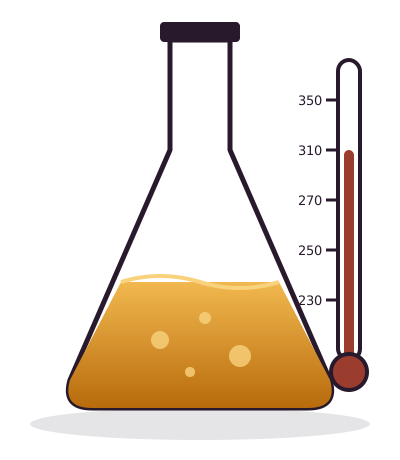
Table sugar wants to be a crystal. Hard candy is what you get when a confectioner stops it from becoming one.
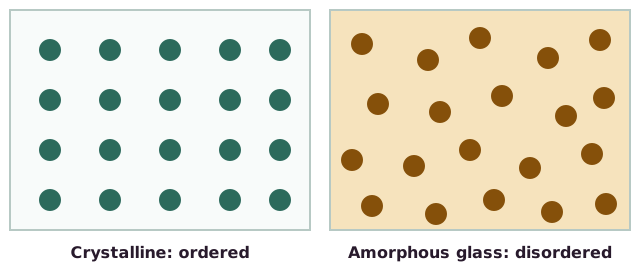
Sucrose dissolves readily in hot water, and as the syrup boils, water leaves as steam and the sugar concentration climbs. By the time the syrup reaches roughly 300 degrees Fahrenheit (149 degrees Celsius), only a percent or two of water remains. Cooled quickly, that dense liquid becomes so viscous that its molecules cannot rearrange into an orderly lattice. They are frozen in place in a disordered arrangement, which is what materials scientists call an amorphous solid, or a glass.
This is why a lollipop is transparent and snaps cleanly, while rock candy is made of visible crystals grown slowly from a saturated solution. Both start with the same molecule. The difference lies in how much time and freedom the molecules are given.
Confectioners use a few tools to prevent graining. Glucose syrup, a starch-derived syrup, adds sugar molecules of different sizes that get in the way of crystal formation. A small amount of acid, such as cream of tartar or citric acid, splits some sucrose into glucose and fructose (a process called inversion), which has a similar effect. Clean pans, minimal stirring and washing down the pan walls remove stray seed crystals that could set off a chain reaction.
The trade-off is moisture. Glass-like sugar attracts water from humid air, and a candy that is over-inverted or left unwrapped turns tacky within hours. Makers wrap or store finished pieces in airtight containers for this reason.
The history of sugar work is long and spread across many cultures. The outline below is a simplified survey, and specialist sources (listed at the end) give the fuller and more carefully dated picture.
Each named stage corresponds to a range of syrup temperature and, therefore, to a water content. The table lists the traditional ranges. The bars in the last column show where each range sits on a scale from 220 to 360 degrees Fahrenheit.
| Stage | Fahrenheit | Celsius | Typical use | On the scale |
|---|---|---|---|---|
| Thread | 230–235 °F | 110–113 °C | Light syrups, glazes | |
| Soft ball | 235–245 °F | 113–118 °C | Fudge, fondant | |
| Firm ball | 245–250 °F | 118–121 °C | Soft caramels | |
| Hard ball | 250–266 °F | 121–130 °C | Nougat, marshmallow | |
| Soft crack | 270–290 °F | 132–143 °C | Taffy, butterscotch | |
| Hard crack | 300–310 °F | 149–154 °C | Hard candy, lollipops | |
| Caramel | 320–350 °F | 160–177 °C | Caramelized sugar, brittle |
Choose a stage, a unit and an elevation to see the adjusted target range. Water boils at a lower temperature at altitude, so syrup targets drop by roughly 1 °F for every 500 feet.
Stage
Display first in
Elevation
Target: 300–310 °F (149–154 °C)
Values shown for sea level. Check your thermometer in boiling water first: it should read about 212 °F (100 °C).
The cooled syrup turns brittle and glassy, with roughly 1 to 2 percent water left. This is the range for hard candy and lollipops.
Plant-derived flavorings are grouped here by the aroma families a taster would recognize. Notes describe taste and aroma only. Nothing in this section is a claim about health, mood or any effect on the body.
One practical rule runs through all of them: volatile aromatics fade at high temperatures, so makers generally add delicate flavorings after the syrup comes off the heat and has settled below the boil.
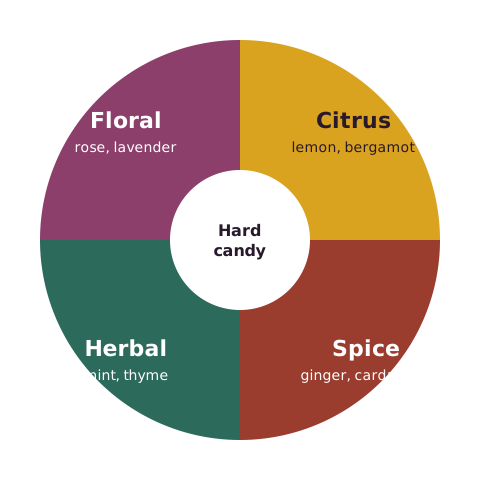
Select a family to narrow the matrix. Some profiles belong to two families.
Showing 10 of 10 pairings.
Floral
Perfumed and rounded, with a faint fruitiness. Easily tips into soapy when overused, so tasters build it up in small steps.
Floral and herbal
Floral on the nose with a resinous, almost camphor-like edge. A little goes a long way.
Floral
Delicate and muscat-like, reminiscent of lychee and pear. Its subtlety is easily masked by strong partners.
Citrus
Bright and sharp. Citric acid also takes part in the chemistry, since acid promotes inversion and shifts the texture of the finished glass.
Citrus and floral
Fragrant citrus with a perfumed, slightly bitter finish, familiar from tea blends.
Spice
Warm, pungent and slightly citrusy. The pungency registers late and lingers on the palate.
Spice
Complex: citrus, pine-like resin and a cool, camphor-like lift. Works in very small amounts.
Spice
Sweet, licorice-like and warm. Dominant, so it suits simple, confident candies.
Herbal
Sweet, green and sharply cooling on the tongue. The cooling is a sensory effect of the aroma compound menthol, not a physical change in temperature.
Herbal
Earthy, savory and faintly floral. Sweet candy gives it a surprising, almost honeyed quality.

Many hard candy formulas can be understood as ratios: glucose syrup at around 40 percent of the sugar weight, and water at around 30 percent. The scaler below multiplies one illustrative base ratio so the proportions stay consistent as a batch grows or shrinks. It is a teaching aid for the arithmetic, not a tested recipe, and ingredient amounts should always be weighed rather than measured by volume.
Batch size: ×1 of the base ratio
Batch size
Units
| Component | Amount | Role |
|---|---|---|
| Granulated sugar | 400 g | Main structure of the glass |
| Glucose syrup | 160 g | Interferes with crystal growth |
| Water | 120 g | Dissolves the sugar; boiled off |
| Flavoring | 4 ml | Added off the heat, to taste |
A consistent routine makes notes comparable from one candy to the next. This is one simple approach, in order:
Readers who want a deeper treatment of the history and chemistry can start with these published works:
Hardboil Folio is an independent culinary publication and botanical taste study. It does not sell products, run a shop or accept payment for placement. Corrections are welcome through the editorial contact page.